FastAmps

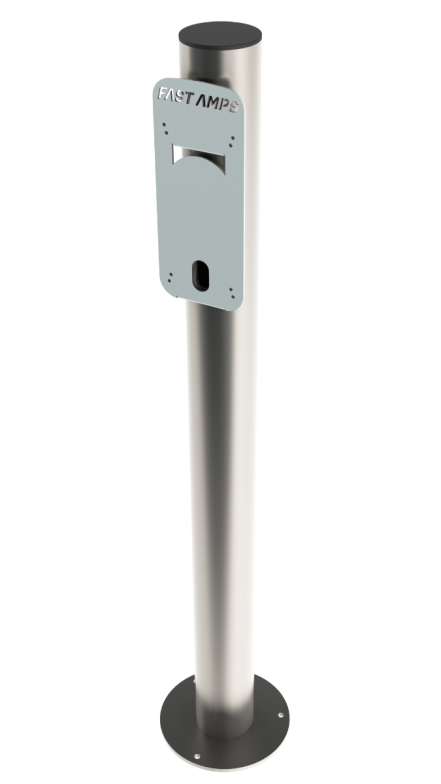
Stainless Steel Charge Post

From £269.00

Where there's no wall, there's a way.

Have any questions? Just let us know

Shop with Confidence at Fast Amps

The finer details

The FastAmps Alpha7 EV charger is suitable for indoor and outdoor use in homes and workplace car parks.  Its simple, compact, robust, and reliable design provides up to 7.4kW (32A) of power. 

Stainless Steel Charge Post specs

  • Weight
    1.0kg

FAQs

Before you buy...

We strongly recommend that you speak to a qualified and experienced installer before you buy an Alpha7 EV charger.  An installer will be able to advise you on: the suitability and complexity of your installation, the most appropriate type of product, and give you an idea of the total cost involved.  Contact us if you have any concerns.

What are the minimum technical requirements?

The Alpha7 needs to be permanently connected to a regular 230V RCD protected supply.  It can be fitted indoors or outdoors, surface or post mounted, and must be fitted at a height of between 0.9 and 1.5m from the ground.  There are no access restrictions.  No WiFi signal or network connection is needed, although a WiFi signal or an EtherNet cable will be needed if you want to access your charger remotely.  The Alpha7 is suitable for private domestic and private workplace locations.  

What's the difference between a socketed and a tethered charger?

A tethered charger has an integrated cable that plugs directly into your car charging port.  A socketed charger uses the charging cable that usually comes with your car: both ends need to be plugged in.  Our standard tethered charger has a 5m cable, long enough for most instances: whist we can also offer 8m and 10m cables.  The tether can look somewhat unsightly: our stainless-steel tether holder can help keep things tidy for you. 


Which one you will like most depends on your preferences.  People who charge every day tend to prefer tethered.  Occasional users and tidy people tend to prefer a socketed charger.  The tethered charger is slightly more expensive.  We ship three socketed chargers for each tethered charger that we ship.  

What's the difference between "Slow", "Fast", "Rapid", and Ultra-Rapid" Charging?

Slow charging uses a 3-pin household plug.  They come on a lead and are sometimes called “granny chargers”.  It typically charges at 2.4kW or ~10 miles of range per hr.  They are OK for small batteries (eg PHEVs) and EV drivers not doing many miles.


Fast charging uses a “wired in” EV charger, like the FastAmps Alpha7.  They charge between 7 and 22kW or ~25 to 90 miles of range per hr.  These are good for overnight or worktime charging.  They use AC (Alternating Current) power and can make use of the charging cable that is normally supplied with your EV.  The FastAmps charger charges at 7.4kW (30 miles of range per hr).  


Rapid charging uses a dedicated high-power installation.  They charge between 37 and 50kW or ~150 to 200 miles of range per hr.  Typically found in car parks and dedicated EV charging stations.  They use DC (Direct Current) power with a larger “CCS” power connector fitted to the charger.  These are good for charging quite quickly: it may take ~1hr to charge from 20 to 80% battery capacity.  The electricity costs are usually higher.


Ultra-rapid charging uses a dedicated high-power installation.  They charge between 150 and 300kW or ~600 to 1,200 miles of range per hr.  Typically found in dedicated EV charging stations.  They use DC (Direct Current) power with a larger “CCS” power connector fitted to the charger.  These are good for charging very quickly: it may take ~20mins to charge from 20 to 80% battery capacity.  The electricity costs are usually higher.


There are a few other considerations though.  Your EV may be limited on charging speeds: a limit of 11kW for AC is common, as is 40 to 100kW for rapid charging: check your car here: https://ev-database.org/uk/.  Lots of rapid charging will degrade the EV battery over time: slower chargers are kinder to the battery and much less expensive to use.  

Is the Alpha7 Easy to Install?

The Alpha7 has been designed with the installer in mind.  The box insert contains a helpful template to aid in marking out the 4 stainless steel mounting screws (supplied).  High-quality DeWalt fixing plugs are also included.  The supply cable can be fitted from any direction.  Extra finger space in the terminal chamber and extra-large terminal apertures will ease installation.  Simple DIP-switch selection configures the output current limit, dynamic load-balancing option, and load sharing.  You’ll be done in no time!

View the Quick Start Guide >

View the Installation & User Guide >

Does the Alpha7 need an earth rod?

The Alpha7 has built-in PEN ground-fault protection in accordance with the 18th Edition Wiring Regulations, section 722.411.4.1 iv.  An integral 30mA AC and 6mA DC earth leakage protection device is also included.  An earth rod or an expensive external PME PEN fault protection device is not required.

Do I need to install the home "Dynamic load-balancing"?

Installers should consider the main incomer fuse rating, the existing installed load, and whether the addition of an EV charger will likely lead to overloading.  The Alpha7 dynamic load monitoring kit is an easy and inexpensive solution to ensure safe and reliable installations.  Don't forget to select one on your order!

Can I Install My own Alpha7?

We would very strongly recommend against this unless you are a professional electrician with a current qualification for the 18th edition wiring regulations: BS EN7671: as well as specific training, certification, and experience in EV charger installation.  We recommend that you speak to a qualified and experienced local installer to arrange this work.  FastAmps do not arrange installations but we can recommend an installer: please contact us if you would like more information.

Are cable glands pre-fitted?

No: differing cable size requirements and a variety of possible cable entry points would mean that we would inevitably supply you product with the wrong size of gland in the wrong place.  The Alpha7 housing helpfully has a number of "dimples" in useful places for correct gland placement, depending on cable configuration.  We do provide a gland with the CT coil which is used for Dynamic Load balancing or for Solar integration.

What size of supply cable do I need?

A qualified installer will be able to answer this question for you, considering the specifics of your installation.  The type of cable also needs to be considered, according installation specifics.  As a guide: for a 16A installation a 4sq mm cable is likely to be required; for a 32A installation a 6sq mm cable is likely unless the installation length is relatively short.

Does the Alpha7 need WiFi?

No, it is optional.  The Alpha7 can use a simple BlueTooth connection to your mobile device, fulfilling the Smart Charge Point Regulations 2021.  WiFi and EtherNet connections are available and an optional part of the installation.  The Alpha7 is simple, straightforward, and reliable.

Where do all of the components come from?

We’re closer than you think!  Because we both design and manufacture in the UK, we are able to take advantage of some of the great manufacturers that we have here in the UK.  


Our plastics are moulded in Birmingham, our PCBs are assembled in Halesowen, the foam seals are squirted in Leamington Spa, the ribbon cable comes from Leicester, the sticky badges from Merseyside, and our boxes and screws are from right here in Shrewsbury.  You are supporting British manufacturing by buying a FastAmps EV charger: we are proud members of MadeInBritain®.

Does the Alpha7 need a network connection?

No, the Alpha7 does not have extra components inside that it does not need; components that would make it less reliable and more expensive.  The Alpha7 uses a simple BlueTooth connection to your mobile device, fulfilling the Smart Charge Point Regulations 2021.  The Alpha7 is simple, straightforward, and reliable.

What are the mounting dimensions?

The mounting dimensions for Alpha7 EV charger are simple and straightforward: 4 off holes in a rectangle 215 by 95mm.  High quality stainless steel screws and DeWalt wall plugs are supplied with the Alpha7.  The drill size for the wall plugs supplied is 8mm, drill depth of at least 40mm.

Alternatively you may wish to consider the FastAmps Alpha7 EV charger mounting post: see the Shop for details.

What Is The Cost Of Installation?

For the simplest installations, in the most competitive parts of the country, prices can start at around £750, including the charger, including labour, and including VAT.  Such an installation might be where the electricity supply is on an outside wall, immediately next to where the charger is to be situated, fitted by an electrician that is very local to the job.


Big cost-drivers include: the number of walls to drill through, the distance between your meter and where you would like the charger to be installed, and how “up to date” your electrics are.  Routing cables under floorboards or through ceilings can take a significant amount of time and digging trenches is very expensive indeed.  Electricians’ rates typically vary from £30 to £60 per hr, but this may increase to over £100 per hr in London: this has a significant bearing on the final cost.


FastAmps have hundreds of installers across the UK with a wealth of EV charger install experience: our friendly team will work with you to find the right installer in your area.

How long will it take to install?

A simple installation can be done by an experienced electrician in a couple of hours.  It can sometimes take a little longer if the installation has more complicated requirements.  The best electricians have busy diaries, so it might take a couple of weeks to get a charger installed, depending on everyone’s diaries.  Let us know if you need an installation more quickly than this, we can normally help out: our friendly team will work with you to find a quick installation solution for you.

Can I claim the OZEV EVHS grant?

Yes.  The Alpha7 fulfills the requirements of both the domestic and workplace schemes.  The domestic scheme applies to homeowners who live in flats or people living in rental accomodation.  You must have dedicated off-street parking, own an EV, and have not already claimed a previous grant.  Note that not all plug-in hybrid cars are eligible.  The full list of rules, on the government website can be found here.  Please talk to your installer about applying for the grant.

Can you recommend an Installer?

Yes, no problem.  Have a look at our map for our list of installers or please contact us if you would like more information or are concerned about a quoted cost for an installation: we can give you advice if you need it.  

What countries can the Alpha7 be installed in?

Just now, FastAmps are selling in the UK market.  The Alpha7 is designed to be compatible throughout Europe and the USA.  Please contact us for further information.

Which cars will work with the Alpha7?

The Alpha7 is compatible with all EVs.

Note that some cars (Pre-2014) from Japan and South Korea (eg Nissan Leaf, Mitsubishi Outlander PHEV, andf Kia Soul) require a type 1 cable and need to use a socketed charger.

How long does it take to charge?

We get asked this question a lot.  The short answer is that it depends on how big and how empty your battery is when you plug in.  

Battery sizes range from 12 to 120kWh: a big difference.  Some cars use less than half the electric than others: a big difference!  A good way to think is “how much range do I get for each hr of charge?”  Tesla 3 (34miles), Mini-E & Renault 5 (30miles), VW ID3 (26miles), Volvo XC40 (22miles), Jaguar I-Pace (20miles), Mercedes G580 (15miles).  

For a full charge: Mitsubishi Outlander PHEV (13.8kWh: 2hrs), Mini-electric (35kWh: 5hrs), Renault 5 (52kWh: 7hrs), Tesla 3 (75kWh: 10hrs), Jaguar I-Pace (85kWh: 12hrs), Mercedes EQS 450+ (108kWh: 15hrs).  An 8hr FastAmps charge will give 160 to 270 miles of range: more than enough for almost any situation.

How Do I Charge My Car?

Check that the Alpha7’s green LED is on: this means it is ready.  Plug one end of the cable into your car and the other end into the charger.  Press the "now" button.  The blue LED will show and that’s it!  The car and the charger will talk to each other and sort everything else out.   It is simple, straightforward, and reliable. 

How Much Does It Cost To Charge?

This very much depends on the price of electricity and the EV that you own.  At the current average price of 30p/kWh, to charge the average car battery (62kWh) from empty to full (an average of 200 miles of range) would cost around £18. 

Switching to a specialised EV tariff (eg EOn Next Drive / British Gas Electric Driver or Octopus Intelligent Go) could reduce the unit cost to less than 6.5p/kWh overnight.  The integration of solar panels can reduce the cost still further.

Prices correct as of November 2025

Which EV tariff should I use?

The energy suppliers certainly do not make it easy to work out how much their electricity is going to cost you!  

We're not experts, but a really useful resource for consumers is the MoneySavingExpert website here: Electric vehicle energy tariffs - Money Saving Expert.  As usual, they are very good at debunking misleading claims and making things very simple to understand.  Don’t be drawn by excellent marketing: they are not always the best value solution.  Pay close attention to the daytime electricity rate as well as the daily standing charges: these can be surprisingly high for some of the tariffs that advertise market-leading overnight electricity prices.  Tariffs change and new deals come on to the market all the time.  Whilst we don’t sell electricity, we are happy to give impartial suggestions to anyone that is unsure: just drop us a line at [email protected] and we will be happy to help.

How Often Should I Charge The Car?

You can charge your car as often as you like.  Most drivers “top-up” every day, when their car is not being used, most often overnight.  In this way you are always ready to go!

What do the LED colours mean?

A green LED means that the charger is “ready” for you to plug your car in to the Alpha7 charger.  A continuous blue LED means that the car is charging.  A pulsing blue LED means that the car has finished charging.  A yellow pulsing LED indicates that the lock has not engaged or disengaged correctly.  A red LED indicates that a fault has occurred.  More LED information can be found in the Installation & User Guide >

What type of cable does the Alpha7 Unit come with?

The Alpha7 does not come with a cable: it is an “untethered” EV charger.  This gives you the flexibility to choose the length and type of cable that is most suitable for your needs.  The tethered version of the charger comes with a 5m (type2) cable: an 8m cable is available as a special order.

View the Installation & User Guide > 

What Kind Of Cable Do I Need?

There are lots of EV charging cables available: here are some tips to help make sure that you don’t end up with the wrong one!

  • You will need a “Type2” to “Type2” cable (unless you have a pre-2014 Japanese / Korean manufactured car).
  • Be careful: the EV charging cables have different power ratings.  You are likely to need a 32Amp cable.  Less expensive 16Amp cables are also available but they will halve the maximum charging speed, allowing only 3.7kW.  A 16Amp cable might be OK for some PHEV vehicles.
  • You can buy either 1phase cables or 3phase cables.  1phase cables are less expensive and weigh less, it will not affect charging on a FastAmps charger but may limit your charging speed on some public chargers.
  • Buy a recognised brand from a reputable source.  We see such a variation in quality and have seen what can happen when charger cables fail.  We really feel that it is not worth saving a few pounds on such an important part of your daily routine: be careful when using online marketplaces.
  • Regularly check the pins of the cable for damage.  Black marks, deformed pins and signs of overheating can signify a poorly cable: this can damage your EV charger and your EV.  Send us a picture if you are worried to [email protected] and we will have a look at it for you. 

How Does the Home dynamic load balancing work?

The Alpha7 dynamic home balancing kit works by using a small cable clamp attached to the input cable of your electricity meter.  The cable clamp measures the total current being supplied to the meter.  Settings, made by your electrician inside the Alpha7 charger, makes sure that the supply current never exceeds the fuse rating.  It does this by reducing the charge rate to the vehicle and only increasing it again when there is enough supply capacity.  Users never need worry about switching on the shower and the cooker whilst the Alpha7 is charging!

Can I Plug An EV Into A Regular Socket?

Yes, this is possible: but it is slow!  It will take 2.5 times longer than using the Alpha7 EV charger.  Most EVs come with such a lead included in case of emergencies.  These are known as "granny chargers".

Why is the cable locked to the charger during charging?

For safety, security, and reliability.  Whilst the car is charging, there is power present on the connector pins: the lock does not allow the plug to be disengaged during charging: it keeps you safe.  The cable lock means that other people cannot unplug your car whilst it is charging: a useful feature.  Unplugging the cable during charging, at full power, can cause damage to both the charger and your car: something that we all want to avoid.  Not all chargers have a cable lock: make sure that you get one that does!

Can I lock the Alpha7 to stop others using it?

The FastAmps mobile App includes a handy feature to disable the charger when owners would like to stop other EV owners from using the charger.  The LED will be "colour changing" when this feature is enabled.  FastAmps App

Why do you use a solenoid rather than a motorised lock?

In the event of a power cut or an RCD fault during charging, a motorised lock will remain engaged.  It means that the cable cannot be removed: this is frustrating.  A solenoid lock automatically retracts in this instance.  A solenoid is more expensive, but we think that it is worth it.  Not many EV chargers have a solenoid lock: make sure that you get one that does!

Can I turn on my car whilst charging?

Many cars will allow you to turn on interior electrics whilst the car is charging eg radio, satnav.  Some cars will allow you to turn on the heating or air conditioning.  No cars will allow you to drive the car (even a very small distance) whilst charging.  Consult your vehicles user manual for further details.

Is it safe to charge in the rain?

Yes, is the short answer; but I imagine you might want to know a little more as to how we make sure that it is safe.

When you plug in your charger, there are no high voltages present on any of the electrical pin contacts.  This is safely “fault-interlocked” with a relay inside the charger, along with at least three other safety features.  When you slide the connector in, some clever design makes sure that the pins safely connect in a certain order, starting with the Earth pin, then the Neutral pin and finally the Live pin.  The two small pins in the connector use safe (isolated) communication voltages: they talk to the car to control when the high voltage is switched on inside the charger.  The first check is an Earth check, then a voltage check.  The car, the charger, and the cable will establish communication with each and predefine a safe charging rate.  It is only after this is complete that high voltage is turned on.  As a further safety measure, the charger is fitted with multiple RCD protections.  RCDs can detect when a person is being given an electric shock.  They react very quickly and can switch off devices very quickly: well before any damage is done to the human body.  These safety devices are independently tested and certified according to international safety standards.

Put all of these safety measures together and you have a charger that you can be sure will keep you safe, whatever the weather.

The plug will not unlock: what do I do?

The Alpha7 will attempt to unlock a number of times before showing the fault LED.  The most likely reason for this to happen is because the cable connector is not quite inserted correctly into the Alpha7 unit.  A wiggle of the cable connector should free things up.  A power cycle of the Alpha 7 (switch it off and on again in the distribution board) may ultimately be required to unlock if a "wiggle" does not work.  Please let us know if you experience this issue, using our Contact Us page.

What is the warranty period?

The Alpha7 is offered with a 3 year warranty.  In the unlikely event of a malfunction, please contact us.

Why is the FastAmps Alpha7 charger easier to install?

This one is for the installers.  It includes some information that is more technical in nature, but feel free to read on if you are interested.

It’s not easy installing: we know that.  We have several innovations that make your life as an installer easier.  

  • You can easily remove the front of the charger by unclipping the ribbon cable: making cable access and mounting easier: simply reclip the ribbon when you are done.
  • The box has a handy mounting template, doubling up as the insert, so that you know where to mark your holes for drilling.
  • We provide you with a T20 security bit in every charger, so that you don’t have to go looking for one in your toolbox.
  • Quality stainless screws and fixings mean that you have what’s needed to fit the charger.
  • A variety of dimples on the bottom of the charger give you somewhere to aim for when cutting the cable-holes.  It means you know that your glands will be centred when you fit them, even up to 32mm glands.
  • Bottom, side, and rear gland mounting options: whatever the situation you know that you will be able to provide a tidy cable option for the customer.
  • Plenty of length in the terminal chamber means that you can even fit 16mm SWA if you need to.
  • Oversized wiring terminals mean that you can always fit your cables in.
  • The BlueTooth® passcode for access to the app is in four places: on the user manual, on the cardboard box, on your delivery paperwork, as well as inside the charger.  It makes it easier to find it when you need to.
  • Simple BlueTooth® commissioning via the FastAmps app on your phone means that you don’t have to find the WiFi unless the customer needs it: how often have you had a customer that doesn’t know what their WiFi password is?
  • A simple app-based solution to enable dynamic load balancing.
  • UK based technical help, from people that have first-hand experience, and who actually answer the phone.  No tickets or “we’ll ring you later” here: immediate help is on hand if you need it.

Try FastAmps out today to see how easy EV charger installation and commissioning can be!

How long will the Alpha7 last?

The Alpha7 has been designed to last well beyond the warranty period of 3 years.  The simple, staightforward design has been engineered to give many years of reliable operation.  Design parameters have been selected to yield a minimum 10 year lifetime under normal operating conditions.

Why do you use stainless steel screws?

Some of our chargers get fitted near to the coast.  Steel screws rust very quickly in this environment; even if they are plated or treated.  We don’t like to cut corners.  It costs a few pence more and is something that we think is a good investment.  We want our chargers to last and to keep looking as good as possible for as long as they can.  

What's good about your RCD protection?

This one is for the installers.  It includes some information that is more technical in nature, but feel free to read on if you are interested.

Before we start, just so that we are all clear (and no matter what anyone says): an RCBO always needs to be fitted to protect the cable for every individual EV charger.  The RCBO must protect both the live and neutral phases.  Notwithstanding that, we have a few features that are useful to make your installation a little easier and end-user service calls a little less likely.

In addition to the required 6mA DC leakage protection, we also have 20mA AC detection integrated inside the unit.  Note that this 20mA AC protection does not perform the same function as a safety-certified RCD or RCBO (to eg EN61009-1) and cannot be used as such.  The 20mA protection is fast-acting and will “catch” earth-leakage events before a typical RCBO certified to EN61009-1.  Charging will stop.  It will automatically reset.  This means that the charger is much less likely to trip the RCBO in the consumer unit: a key cause of customer calls for assistance.  This feature is also very helpful when testing the EV charger with your EV charger tester as part of the commissioning process: the number of automatic on-board RCD resets correlates with the number of RCD tests that the EV charger tester completes.  It means that the EV charger does not need to be power cycled, after each RCD test, as part of the test process.  This saves you valuable time as an installer.

What Maintenance or Servicing is required for the Alpha7?

The Alpha7 is designed to be completely maintenance-free.  There are no maintenance or service schedules that need to be observed.  Keeping your charging cable connector free from dirt will help ensure trouble-free operation.  The plastic enclosure can be cleaned using a non-abrasive sponge and a pH neutral cleaner.  Please contact us if you have any specific concerns.

What happens if my Alpha7 goes wrong?

In the unlikely event, Contact us and we will do our very best to make sure that you are back charging as soon as possible.

How do I get spare parts?

Whilst we don't expect that you will need any spare parts for your Alpha7 charger, please contact us in this instance.

How do I change the default charging times?

All Alpha7 chargers are pre-programmed to charge only during off-peak hours.  This helps the UK electrical grid avoid overloading at peak times (07:00 - 11:00, 16:00 - 22:00).  This is a requirement as part of the Smart Charge Point Regulations 2021.  The charging hours can be over-ridden at any time by pressing the "now" button.  Alternatively, the user can set different hours, perhaps to synchronise with variable price tariffs.  This functionality is offered through the FastAmps App

Be sure to make sure that charging times are only set in either the FastAmps charger or the car, not both.

How do I download the FastAmps App?

Downloading the Mobile App is easy.  Search for "FastAmps" on the Google or Apple store or click on the link here.

How do I see how much electricity I have used?

This information is available on the "History" screen of the FastAmps App

How do I download the data for OZEV reporting?

Usage data, suitable for OZEV grant reporting, can be emailed as a .csv file by using the FastAmps App 

Is there a volume discount?

Yes.  Contact us if you re regularly buying Alpha7 chargers or if you need larger quantities: we would love to meet up with you.

Can I set up an account with FastAmps?

FastAmps are happy to arrange accounts and terms for regular customers.  Contact us for more information.

What's the difference between Type1, Type2, CCS2, and Chademo connectors?

Type1 and type2 connectors are lower power, AC charging, connectors that you are likely to use at home.  Type 1 connectors are no longer fitted to vehicles and are only found on older cars (pre-2014) that were typically imported from Japan and Korea (eg Nissan Leaf, Mitsubishi Outlander PHEV, and Kia Soul).  All cars now sold in the UK have a type2 connector fitted.


CCS2 and Chademo are high power, DC charging, connectors that you will find attached to rapid charging stations.  Chademo connectors are no longer fitted to vehicles and are only found on older cars (pre-2014) that were typically imported from Japan (eg Nissan Leaf, Mitsubishi Outlander PHEV, and Kia Soul).  Chademo connectors are limited to 50kW.  All cars now sold in the UK have a CCS2 connector fitted.

Here's a picture of what the different connectors look like:

What about the Solar Integration?

Enabling the Solar Integration with your Alpha7 EV charger has the potential to significantly reduce your electricity bills.  A current clamp is fitted to the output of your solar array.  When connected to the Alpha7, the current clamp gives a signal informing the Alpha7 charger how much power the solar array is producing.  The Alpha7 charger can use this signal, 4 times per second, to match the EV charging output to the power generated by the array, up to a maximum of 32 amps.  Pressing the solar button enables this function.  The green LED above the solar button is lit when this function is active.  When operational, the maximum current drawn from the mains will be 6 amps.  The Alpha7 will operate as a normal charger when the solar button LED is not lit.  It is set to "inoperative" as default, to avoid unintentional operation.  This function (if required) is enabled using the Fastamps App.  


Don't just take our word for it!

“Thanks for sorting out the charger so quickly. I am very impressed with how easy they are to set up and install. I installed this one in 2 hours.”

Dylan, North Wales

Don't just take our word for it!

"From putting in the enquiry to the order being completed, was excellent. The fitter was knowledgeable, professional, did the job efficiently and quickly. There was no mess after installation and he went through the app to ensure understanding. Excellent service."

Stacy

Don't just take our word for it!

"This is simply the best charger. Having recently been let down badly by a competitors unit that only lasted a couple of years and being told no support was available Fast Amps stepped in and helped by recommending a fitter and product that was suitable for my needs, in modern times this level of service is very rare. If you are looking for a charger why would you go anywhere else."

Brian

Don't just take our word for it!

"FastAmps have been incredible. The explanation given pre sale for someone who is new to electric vehicle charging is second to none. Post sale we had one issue but that was a user error on my part nevertheless they were on hand immediately to help. Competitively priced unit, no fancy gizmos, just the key features you need from a car charger. They’re local too which is a bonus."

Simon