
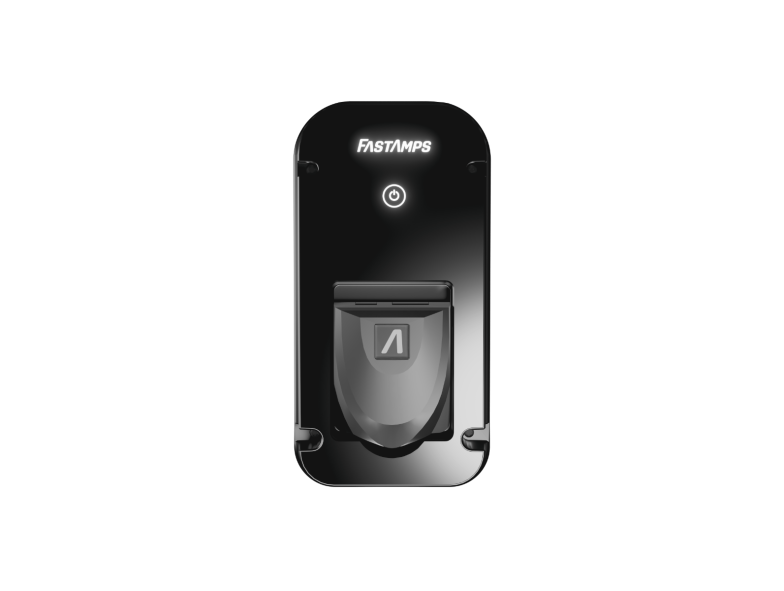
FastAmps
Alpha7 EV Charger
From
£399.00
The FastAmps Alpha7 EV charger is suitable for indoor and outdoor use in homes and workplace car parks. Its simple, compact, robust, and reliable design provides up to 7.4kW (32A) of power.
Key Features
- Dynamic Solar Charging
- 3-Year Warranty
- WiFi, Bluetooth and Ethernet Enabled
Alpha7 EV Charger
The FastAmps Alpha7 EV charger is built to fit effortlessly into everyday life, whether that’s at home, at work, or somewhere in between. Sleek, reliable, and seriously capable, it’s designed to work with all electric vehicles while making life easier for both customers and installers. Faster installs, smooth performance, and a charging experience that just…works.
With its clean, compact design, the Alpha7 looks right at home wherever you place it. Tucked into a garage or mounted on a driveway, it keeps things looking sharp without taking over the space. And thanks to its weather-resistant build, it’s ready for whatever the British weather decides to throw at it.
Control is simple, too. Use the unit itself or hop onto the FastAmps app to schedule charging around your day. Choose to plug in overnight, top up while you’re home or wake up ready to go. You’ll also have real-time charging insights at your fingertips, so you’re always in the know, wherever you are.
Behind it all is a team with over 100 years of combined experience in electronic design and manufacturing - bringing together the kind of expertise that turns a good charger into a great one.
The finer details
The FastAmps Alpha7 EV charger is suitable for indoor and outdoor use in homes and workplace car parks. Its simple, compact, robust, and reliable design provides up to 7.4kW (32A) of power.
Alpha7 EV Charger specs
-
Electrical Rating7.4kW, 220-240V, 50/60Hz, 32A
-
Earth Leakage ProtectionIntegrated 30mA AC, 6mA DC earth fault protection, & built-in PEN fault detection
-
Over-current protectionInternal (Dynamic)
-
Operating temperature-30°C to +50°C
-
Socket typeType 2, EN62196 connector
-
LED IndicationIntegrated LED charging status indicator
-
Standby power consumption~2.7 watts
-
Dimensions(H)270 mm x (W)140 mm x (D)110 mm
-
Weight1.1kg
-
Enclosure ratingIP54, Fire retardant, UV stabilized, impact & corrosion resistant
-
CertificationsUKCA & CE to EN 61851-1, EN 61439-1&7, EN62196-1&2, EN 62955
FAQs
For Users
Before you buy...
We strongly recommend that you speak to a qualified and experienced installer before you buy an Alpha7 EV charger. An installer will be able to advise you on: the suitability and complexity of your installation, the most appropriate type of product, and give you an idea of the total cost involved. Contact us if you have any concerns.
What's the difference between a socketed and a tethered charger?
A tethered charger has an integrated cable that plugs directly into your car charging port. A socketed charger uses the charging cable that usually comes with your car: both ends need to be plugged in. Our standard tethered charger has a 5m cable, long enough for most instances: whist we can also offer 8m and 10m cables. The tether can look somewhat unsightly: our stainless-steel tether holder can help keep things tidy for you.
Which one you will like most depends on your preferences. People who charge every day tend to prefer tethered. Occasional users and tidy people tend to prefer a socketed charger. The tethered charger is slightly more expensive. We ship three socketed chargers for each tethered charger that we ship.
What's the difference between "Slow", "Fast", "Rapid", and Ultra-Rapid" Charging?
Slow charging uses a 3-pin household plug. They come on a lead and are sometimes called “granny chargers”. It typically charges at 2.4kW or ~10 miles of range per hr. They are OK for small batteries (eg PHEVs) and EV drivers not doing many miles.
Fast charging uses a “wired in” EV charger, like the FastAmps Alpha7. They charge between 7 and 22kW or ~25 to 90 miles of range per hr. These are good for overnight or worktime charging. They use AC (Alternating Current) power and can make use of the charging cable that is normally supplied with your EV. The FastAmps charger charges at 7.4kW (30 miles of range per hr).
Rapid charging uses a dedicated high-power installation. They charge between 37 and 50kW or ~150 to 200 miles of range per hr. Typically found in car parks and dedicated EV charging stations. They use DC (Direct Current) power with a larger “CCS” power connector fitted to the charger. These are good for charging quite quickly: it may take ~1hr to charge from 20 to 80% battery capacity. The electricity costs are usually higher.
Ultra-rapid charging uses a dedicated high-power installation. They charge between 150 and 300kW or ~600 to 1,200 miles of range per hr. Typically found in dedicated EV charging stations. They use DC (Direct Current) power with a larger “CCS” power connector fitted to the charger. These are good for charging very quickly: it may take ~20mins to charge from 20 to 80% battery capacity. The electricity costs are usually higher.
There are a few other considerations though. Your EV may be limited on charging speeds: a limit of 11kW for AC is common, as is 40 to 100kW for rapid charging: check your car here: https://ev-database.org/uk/. Lots of rapid charging will degrade the EV battery over time: slower chargers are kinder to the battery and much less expensive to use.
Does the Alpha7 need WiFi?
No, it is optional. The Alpha7 can use a simple BlueTooth connection to your mobile device, fulfilling the Smart Charge Point Regulations 2021. WiFi and EtherNet connections are available and an optional part of the installation. The Alpha7 is simple, straightforward, and reliable.
Does the Alpha7 need a network connection?
No, the Alpha7 does not have extra components inside that it does not need; components that would make it less reliable and more expensive. The Alpha7 uses a simple BlueTooth connection to your mobile device, fulfilling the Smart Charge Point Regulations 2021. The Alpha7 is simple, straightforward, and reliable.
Which cars will work with the Alpha7?
The Alpha7 is compatible with all EVs.
Note that some cars (Pre-2014) from Japan and South Korea (eg Nissan Leaf, Mitsubishi Outlander PHEV, andf Kia Soul) require a type 1 cable and need to use a socketed charger.
How long does it take to charge?
We get asked this question a lot. The short answer is that it depends on how big and how empty your battery is when you plug in.
Battery sizes range from 12 to 120kWh: a big difference. Some cars use less than half the electric than others: a big difference! A good way to think is “how much range do I get for each hr of charge?” Tesla 3 (34miles), Mini-E & Renault 5 (30miles), VW ID3 (26miles), Volvo XC40 (22miles), Jaguar I-Pace (20miles), Mercedes G580 (15miles).
For a full charge: Mitsubishi Outlander PHEV (13.8kWh: 2hrs), Mini-electric (35kWh: 5hrs), Renault 5 (52kWh: 7hrs), Tesla 3 (75kWh: 10hrs), Jaguar I-Pace (85kWh: 12hrs), Mercedes EQS 450+ (108kWh: 15hrs). An 8hr FastAmps charge will give 160 to 270 miles of range: more than enough for almost any situation.
How much does it cost to charge my car with the Alpha7?
This very much depends on the price of electricity and the EV that you own. At the current average price of 30p/kWh, to charge the average car battery (62kWh) from empty to full (an average of 200 miles of range) would cost around £18.
Switching to a specialised EV tariff (eg EOn Next Drive / British Gas Electric Driver or Octopus Intelligent Go) could reduce the unit cost to less than 6.5p/kWh overnight. The integration of solar panels can reduce the cost still further.
Prices correct as of November 2025
Which EV tariff should I use?
The energy suppliers certainly do not make it easy to work out how much their electricity is going to cost you!
We're not experts, but a really useful resource for consumers is the MoneySavingExpert website here: Electric vehicle energy tariffs - Money Saving Expert. As usual, they are very good at debunking misleading claims and making things very simple to understand. Don’t be drawn by excellent marketing: they are not always the best value solution. Pay close attention to the daytime electricity rate as well as the daily standing charges: these can be surprisingly high for some of the tariffs that advertise market-leading overnight electricity prices. Tariffs change and new deals come on to the market all the time. Whilst we don’t sell electricity, we are happy to give impartial suggestions to anyone that is unsure: just drop us a line at [email protected] and we will be happy to help.
How often should I charge my car with the Alpha7 charger?
You can charge your car as often as you like. Most drivers “top-up” every day, when their car is not being used, most often overnight. In this way you are always ready to go!
What do the LED colours mean on the Alpha7?
A green LED means that the charger is “ready” for you to plug your car in to the Alpha7 charger. A continuous blue LED means that the car is charging. A pulsing blue LED means that the car has finished charging. A yellow pulsing LED indicates that the lock has not engaged or disengaged correctly. A red LED indicates that a fault has occurred. More LED information can be found in the Installation & User Guide >.
What maintenance or servicing is required for the Alpha7?
The Alpha7 is designed to be completely maintenance-free. There are no maintenance or service schedules that need to be observed. Keeping your charging cable connector free from dirt will help ensure trouble-free operation. The plastic enclosure can be cleaned using a non-abrasive sponge and a pH neutral cleaner. Please contact us if you have any specific concerns.
How do I change the default charging times on my Alpha7 charger?
All Alpha7 chargers are pre-programmed to charge only during off-peak hours. This helps the UK electrical grid avoid overloading at peak times (07:00 - 11:00, 16:00 - 22:00). This is a requirement as part of the Smart Charge Point Regulations 2021. The charging hours can be over-ridden at any time by pressing the "now" button. Alternatively, the user can set different hours, perhaps to synchronise with variable price tariffs. This functionality is offered through the FastAmps App
Be sure to make sure that charging times are only set in either the FastAmps charger or the car, not both.