
Resources
FAQs
Gen4 Installation Guide
Gen4 Tethered Quickstart
Gen4 Untethered Quickstart
Gen3 Installation Guide (Archive)
Gen3 Tethered Quickstart (Archive)
Gen3 Untethered Quickstart (Archive)
Gen2 Installation Guide (Archive)
Gen2 Tethered Quickstart (Archive)
Gen2 Untethered Quickstart (Archive)
For Users
Before you buy...
We strongly recommend that you speak to a qualified and experienced installer before you buy an Alpha7 EV charger. An installer will be able to advise you on: the suitability and complexity of your installation, the most appropriate type of product, and give you an idea of the total cost involved. Contact us if you have any concerns.
What size of supply cable do I need?
A qualified installer will be able to answer this question for you, considering the specifics of your installation. The type of cable also needs to be considered, according installation specifics. As a guide: for a 16A installation a 4sq mm cable is likely to be required; for a 32A installation a 6sq mm cable is likely unless the installation length is relatively short.
Where do all of the components come from?
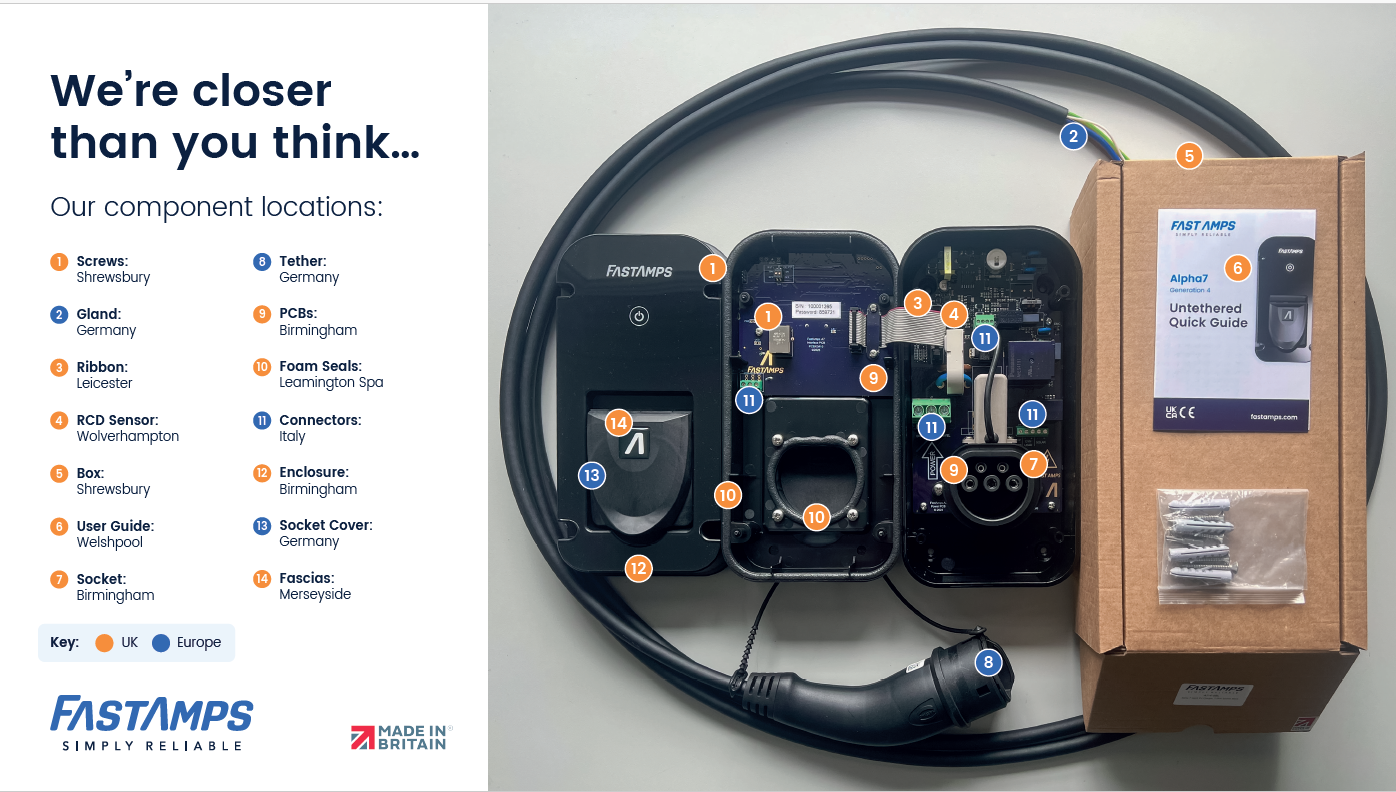
We’re closer than you think! Because we both design and manufacture in the UK, we are able to take advantage of some of the great manufacturers that we have here in the UK.
Our plastics are moulded in Birmingham, our PCBs are assembled in Halesowen, the foam seals are squirted in Leamington Spa, the ribbon cable comes from Leicester, the sticky badges from Merseyside, and our boxes and screws are from right here in Shrewsbury. You are supporting British manufacturing by buying a FastAmps EV charger: we are proud members of MadeInBritain®.
What is the cost of installation?
For the simplest installations, in the most competitive parts of the country, prices can start at around £750, including the charger, including labour, and including VAT. Such an installation might be where the electricity supply is on an outside wall, immediately next to where the charger is to be situated, fitted by an electrician that is very local to the job.
Big cost-drivers include: the number of walls to drill through, the distance between your meter and where you would like the charger to be installed, and how “up to date” your electrics are. Routing cables under floorboards or through ceilings can take a significant amount of time and digging trenches is very expensive indeed. Electricians’ rates typically vary from £30 to £60 per hr, but this may increase to over £100 per hr in London: this has a significant bearing on the final cost.
FastAmps have hundreds of installers across the UK with a wealth of EV charger install experience: our friendly team will work with you to find the right installer in your area.
How long will it take to install?
A simple installation can be done by an experienced electrician in a couple of hours. It can sometimes take a little longer if the installation has more complicated requirements. The best electricians have busy diaries, so it might take a couple of weeks to get a charger installed, depending on everyone’s diaries. Let us know if you need an installation more quickly than this, we can normally help out: our friendly team will work with you to find a quick installation solution for you.
Can you recommend an Installer?
Yes, no problem. Have a look at our map for our list of installers or please contact us if you would like more information or are concerned about a quoted cost for an installation: we can give you advice if you need it.
What countries can the Alpha7 be installed in?
Just now, FastAmps are selling in the UK market. The Alpha7 is designed to be compatible throughout Europe and the USA. Please contact us for further information.
How do I charge my car?
Check that the Alpha7’s green LED is on: this means it is ready. Plug one end of the cable into your car and the other end into the charger. Press the "now" button. The blue LED will show and that’s it! The car and the charger will talk to each other and sort everything else out. It is simple, straightforward, and reliable.
What type of cable does the Alpha7 Unit come with?
The Alpha7 does not come with a cable: it is an “untethered” EV charger. This gives you the flexibility to choose the length and type of cable that is most suitable for your needs. The tethered version of the charger comes with a 5m (type2) cable: an 8m cable is available as a special order.
How does the home dynamic load balancing work?
The Alpha7 dynamic home balancing kit works by using a small cable clamp attached to the input cable of your electricity meter. The cable clamp measures the total current being supplied to the meter. Settings, made by your electrician inside the Alpha7 charger, makes sure that the supply current never exceeds the fuse rating. It does this by reducing the charge rate to the vehicle and only increasing it again when there is enough supply capacity. Users never need worry about switching on the shower and the cooker whilst the Alpha7 is charging!
Can I plug an electric vehicle charger into a regular socket?
Yes, this is possible: but it is slow! It will take 2.5 times longer than using the Alpha7 EV charger. Most EVs come with such a lead included in case of emergencies. These are known as "granny chargers".
Why is the cable locked to the charger during charging?
For safety, security, and reliability. Whilst the car is charging, there is power present on the connector pins: the lock does not allow the plug to be disengaged during charging: it keeps you safe. The cable lock means that other people cannot unplug your car whilst it is charging: a useful feature. Unplugging the cable during charging, at full power, can cause damage to both the charger and your car: something that we all want to avoid. Not all chargers have a cable lock: make sure that you get one that does!
Can I lock the Alpha7 to stop others using it?
The FastAmps mobile App includes a handy feature to disable the charger when owners would like to stop other EV owners from using the charger. The LED will be "colour changing" when this feature is enabled. FastAmps App
Is it safe to charge in the rain?
Yes, is the short answer; but I imagine you might want to know a little more as to how we make sure that it is safe.
When you plug in your charger, there are no high voltages present on any of the electrical pin contacts. This is safely “fault-interlocked” with a relay inside the charger, along with at least three other safety features. When you slide the connector in, some clever design makes sure that the pins safely connect in a certain order, starting with the Earth pin, then the Neutral pin and finally the Live pin. The two small pins in the connector use safe (isolated) communication voltages: they talk to the car to control when the high voltage is switched on inside the charger. The first check is an Earth check, then a voltage check. The car, the charger, and the cable will establish communication with each and predefine a safe charging rate. It is only after this is complete that high voltage is turned on. As a further safety measure, the charger is fitted with multiple RCD protections. RCDs can detect when a person is being given an electric shock. They react very quickly and can switch off devices very quickly: well before any damage is done to the human body. These safety devices are independently tested and certified according to international safety standards.
Put all of these safety measures together and you have a charger that you can be sure will keep you safe, whatever the weather.
The plug will not unlock on my ev charger: what do I do?
The Alpha7 will attempt to unlock a number of times before showing the fault LED. The most likely reason for this to happen is because the cable connector is not quite inserted correctly into the Alpha7 unit. A wiggle of the cable connector should free things up. A power cycle of the Alpha 7 (switch it off and on again in the distribution board) may ultimately be required to unlock if a "wiggle" does not work. Please let us know if you experience this issue, using our Contact Us page.
What is the warranty period for the Alpha7 charger?
The Alpha7 is offered with a 3 year warranty. In the unlikely event of a malfunction, please contact us.
Who should I speak to if I need help with my Alpha7 charger?
In the unlikely event, Contact us and we will do our very best to make sure that you are back charging as soon as possible.
How do I see how much electricity I have used?
This information is available on the "History" screen of the FastAmps App
How to enable the solar integration on my Alpha7?
Enabling the Solar Integration with your Alpha7 EV charger has the potential to significantly reduce your electricity bills. A current clamp is fitted to the output of your solar array. When connected to the Alpha7, the current clamp gives a signal informing the Alpha7 charger how much power the solar array is producing. The Alpha7 charger can use this signal, 4 times per second, to match the EV charging output to the power generated by the array, up to a maximum of 32 amps. Pressing the solar button enables this function. The green LED above the solar button is lit when this function is active. When operational, the maximum current drawn from the mains will be 6 amps. The Alpha7 will operate as a normal charger when the solar button LED is not lit. It is set to "inoperative" as default, to avoid unintentional operation. This function (if required) is enabled using the Fastamps App.
For Installers
Why do you use stainless steel screws?
Some of our chargers get fitted near to the coast. Steel screws rust very quickly in this environment; even if they are plated or treated. We don’t like to cut corners. It costs a few pence more and is something that we think is a good investment. We want our chargers to last and to keep looking as good as possible for as long as they can.
What's good about your RCD protection?
Before we start, just so that we are all clear (and no matter what anyone says): an RCBO always needs to be fitted to protect the cable for every individual EV charger. The RCBO must protect both the live and neutral phases. Notwithstanding that, we have a few features that are useful to make your installation a little easier and end-user service calls a little less likely.
In addition to the required 6mA DC leakage protection, we also have 20mA AC detection integrated inside the unit. Note that this 20mA AC protection does not perform the same function as a safety-certified RCD or RCBO (to eg EN61009-1) and cannot be used as such. The 20mA protection is fast-acting and will “catch” earth-leakage events before a typical RCBO certified to EN61009-1. Charging will stop. It will automatically reset. This means that the charger is much less likely to trip the RCBO in the consumer unit: a key cause of customer calls for assistance. This feature is also very helpful when testing the EV charger with your EV charger tester as part of the commissioning process: the number of automatic on-board RCD resets correlates with the number of RCD tests that the EV charger tester completes. It means that the EV charger does not need to be power cycled, after each RCD test, as part of the test process. This saves you valuable time as an installer.
How do I get spare parts?
Whilst we don't expect that you will need any spare parts for your Alpha7 charger, please contact us in this instance.